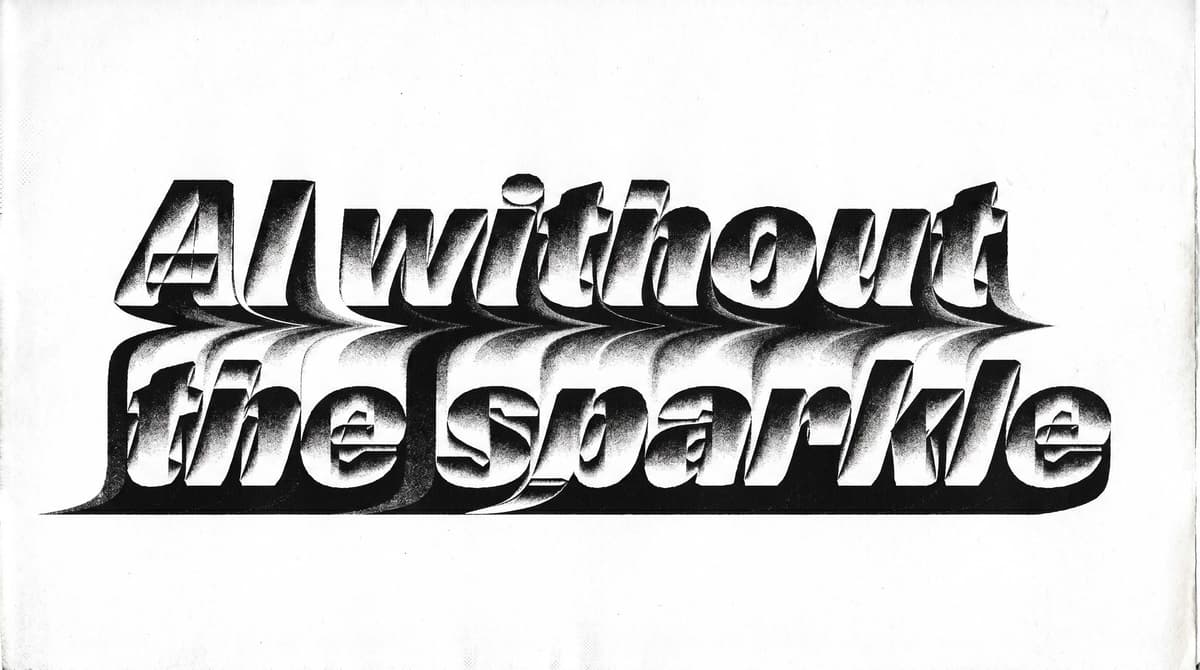
The famous AI logos already have their think-pieces — including our own piece on the two schools of AI branding. Perplexity, Claude, ChatGPT, Gemini, Copilot, Apple Intelligence, Grok — the visual register of frontier AI is now familiar enough to argue about. The interesting work, in 2025 and into 2026, has moved one tier down: smaller AI startups commissioning real identity systems from real studios, often with explicit instructions to avoid the category template.
The pattern that emerges across a dozen of these projects is unusually clear. The studios are not trying to visualize intelligence — sparkles, gradients, glowing orbs, four-pointed stars — they are trying to design around it. Suki's BUCK case study names the cliché directly. Otherway's Robin AI refresh quotes the brief out loud. Koto's Faculty work reaches for civic typography instead of futurism. Pentagram's Pienso identity rejects "AI as black-box magic" in favor of Bauhaus blocks. Twelve of these projects, taken together, look less like a stylistic movement and more like a coordinated retreat from the visual conventions that dominated AI branding from 2022 to 2024.
The strongest AI identities in 2026 are not trying to depict intelligence. They are trying to design permission.
Suki: yellow, on purpose
The clearest articulation of the anti-cliché thesis comes from BUCK's Suki case study. Suki is an ambient clinical voice assistant — the kind of product that sits in the room while a doctor talks to a patient and turns the conversation into a chart note. The category default for a tool like that is some shade of medical blue or "responsible" green, plus a soft glow.
BUCK said no, in print: the studio explicitly named "abstract gradients and glowing orbs" as the conventions it set out to avoid. The system the team built — credited to Camille Chu, Simon Chong, and Surabhi Rathi at BUCK, with web partner Wild — landed on a deep, unfashionable yellow as the primary brand color, paired with a two-line graphic system that reads more like editorial signage than SaaS UI.
The strategic argument is that the design problem in healthcare AI is not "make this feel intelligent." It's "make this feel like presence" — a clinician is supposed to be more present with the patient when Suki is on, not less. Yellow is the color of attention. The blue glow would have signaled the opposite.
Robin AI: legal as a forest
A similar move shows up in Otherway's 2025 refresh of Robin AI, an AI contract-review platform. The brief, as Otherway told Creative Boom, was to walk away from "blue magic stars" and the standard legaltech palette. The studio replaced them with something closer to natural history: a robin-redbreast color logic, a heavy serif wordmark, and a series of painted forest landscapes by illustrator Ariel Lee.
The case study frames the work under a "New Legal" banner, which on paper is the kind of phrase that should set off alarms — categorical rebrand language usually means the underlying product hasn't changed and the brand is doing all the work. Here, the visual choices are specific enough that the frame holds. A serif this dense doesn't get used in legaltech. Painted landscape illustration as a metadata layer for contract software is a real argument: the work is positioning AI legal review as a change-of-place, not a productivity upgrade.
The risk Otherway took is that warmth in a high-stakes category can read as evasion. Robin's bet is that lawyers, who already cope with formal severity in their professional lives, will respond to a brand that feels closer to a small press than to enterprise software. So far the bet has held; the named credits — Rosie Pearmain and Jordan Mann at Otherway, with Lee on illustration — show up consistently across the case study and the press coverage.
LangChain: a parrot that became a bird
LangChain is the rare AI brand that started as an open-source dev tool and grew into a platform — LangSmith, LangGraph, the broader agent ecosystem. The original mark was a parrot, a developer-community joke about "stochastic parrots" that did real work in the early years. Play Studio's rebrand kept the bird and reframed it.
The new identity treats the bird as a flight system. As Play puts it on the case page: "LangChain is the iteration engine that allows agents to take flight." The wordmark is set in Lausanne by Weltkern — a face that lives somewhere between Swiss neutrality and warm humanism — and the palette is split between sky-mode and dark-mode developer surfaces. There's an icon system derived from the bird, sub-marks for product lines, and just enough whimsy left in the symbol to keep the original community from feeling sold-out.
It's a useful counterweight to the rest of this list. Most of these brands are about exiting a category convention. LangChain's challenge was almost the opposite: how to professionalize an open-source culture without sanding the personality off the original mark. The answer was to extend the bird, not replace it.
Cohere: typography as machine
The most rigorous typographic argument in the smaller-AI tier comes from NaN, the type foundry/studio behind Cohere's identity. Cohere's product is unglamorous on purpose — enterprise LLM APIs sold to businesses, mostly. The brand could easily have been a generic blue gradient. It isn't. NaN built a custom headline type with organic, Voronoi-like cuts that disperse through the letterforms — a generative visual logic embedded inside the typography itself.
NaN's argument for Cohere is that the typography is the metaphor for machine intelligence — not the gradient on top.
It's a deeper move than a "techy font choice." Most AI brands push the metaphor outward — into orb marks, motion loops, blob renderings — and leave the typography neutral. Cohere reverses the layers: the typography carries the algorithmic logic, and the rest of the brand is calm enough to let it speak. (Some sources also credit Pentagram with elements of the broader Cohere program; that scope is unverified by the studio's own page, so the safest attribution is NaN for the type.)
If you take this case seriously, it implies that the dominant AI brand mistake of the last three years has been topological: studios painting the gradient on the wrapper instead of building the idea into the typeface.
Faculty: civic memory as a trust device
Koto's identity for Faculty, the UK applied-AI company, takes the opposite path from most "frontier AI" branding. Where the category reaches for futurism, Koto reached for civic memory. Faculty Glyphic, the custom typeface developed by Koto's Dylan Young and reported on by Creative Review on December 12, 2024, draws explicitly on Albertus, on London public-signage history, and on Alan Turing as a reference point.
The argument is that frontier AI work — Faculty's clients include UK government agencies and the NHS — needs to feel publicly accountable, not magical. Albertus was carved into stone before it was set in metal; using it as the reference for an AI identity is a way of saying: this technology should fit into the same category of public infrastructure as a memorial or a transit map.
It's a defensible thesis with an obvious risk. Heritage typography can read as respectability theater — the kind of move that makes a startup look more serious without changing what it does. Faculty mostly stays on the right side of that line because the studio paired the type with a restrained, institutional palette and avoided the heritage cliché of mixing a serif with a glow. The lesson elsewhere: civic typography only works as a trust device if the rest of the brand is willing to be quiet enough to let it.
Pienso: AI as a workshop, not a black box
Pentagram's identity for Pienso — the no-code machine-learning platform — is the strongest case in the set against the "AI as magic" register. Pienso's product lets non-engineers build classifiers and pipelines by direct manipulation; the brand had to argue that this is configurable, modular, legible — the opposite of black-box mystique.
The system, introduced on Pienso's blog on August 6, 2024 and covered by Creative Boom on September 25, 2024, uses a Bauhaus-inflected block language: cube-like primary mark, modular product graphics, and an "Optimistic Navigator" persona that stands in for the user. The work was led by Jody Hudson-Powell at Pentagram London (verify against the studio's full credits before quoting individuals).
What makes this case worth writing about is what Pentagram refused to do. There's no four-pointed star anywhere in the system. There's no glow. There's no AI-themed gradient. The brand makes the argument by what it leaves out. The product's promise — that you can build a model the way you'd build with blocks — is held entirely in the geometric logic, not in any "intelligent" affordance.
Parloa: letters that un-blur
Further's identity for Parloa, a German enterprise conversational-AI platform, makes the boldest typographic argument in the set. Further chose Exposure by 205TF for the wordmark and motion system — a face whose letterforms appear, in motion, to un-blur. The studio's design director Filipe Peregrino told Merchery on March 24, 2026 that the choice was deliberate: the un-blurring is meant to read like memory forming, like a thought becoming legible.
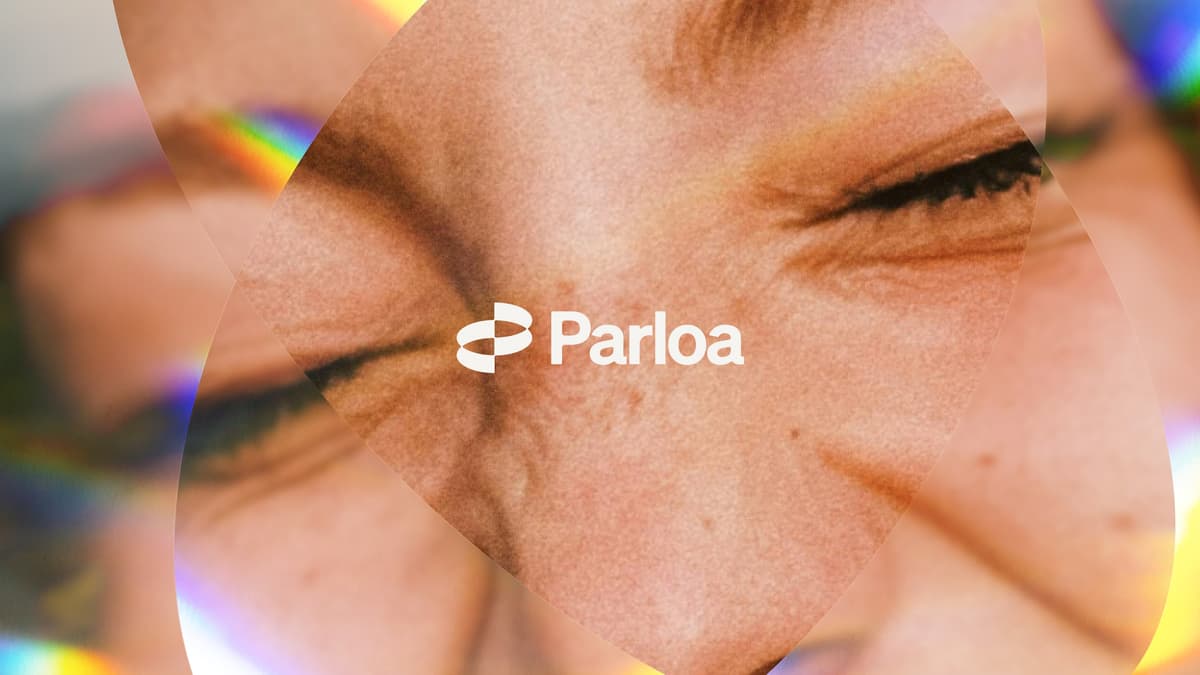
The rest of the system — overlapping lens marks, gradient/lens motion, an "AI is the new UI" tagline — is more familiar; this is the part of the case that flirts with category cliché. The lens motif is close enough to the orb-and-glow vocabulary that a less rigorous team would have ended up exactly inside it. What rescues the work is the typographic layer underneath, doing real metaphorical work that the lens alone couldn't.
It's a good test of how much weight type can carry. The lens is decoration; the typeface is the argument. If you remove the typography, Parloa is a generic agent-AI brand. With it, it becomes a piece about emergence.
Heidi: symmetry, ripples, and the new healthcare boilerplate
DixonBaxi's identity for Heidi, the medical AI scribe, is the most polished healthcare case in the set — and the one where the cliché map has the firmest grip. Heidi is an "AI that makes care more human," the case study says. The visual system is built around a perfectly symmetrical H, harmony and balance language, and cymatic ripple patterns that suggest both sound and water.
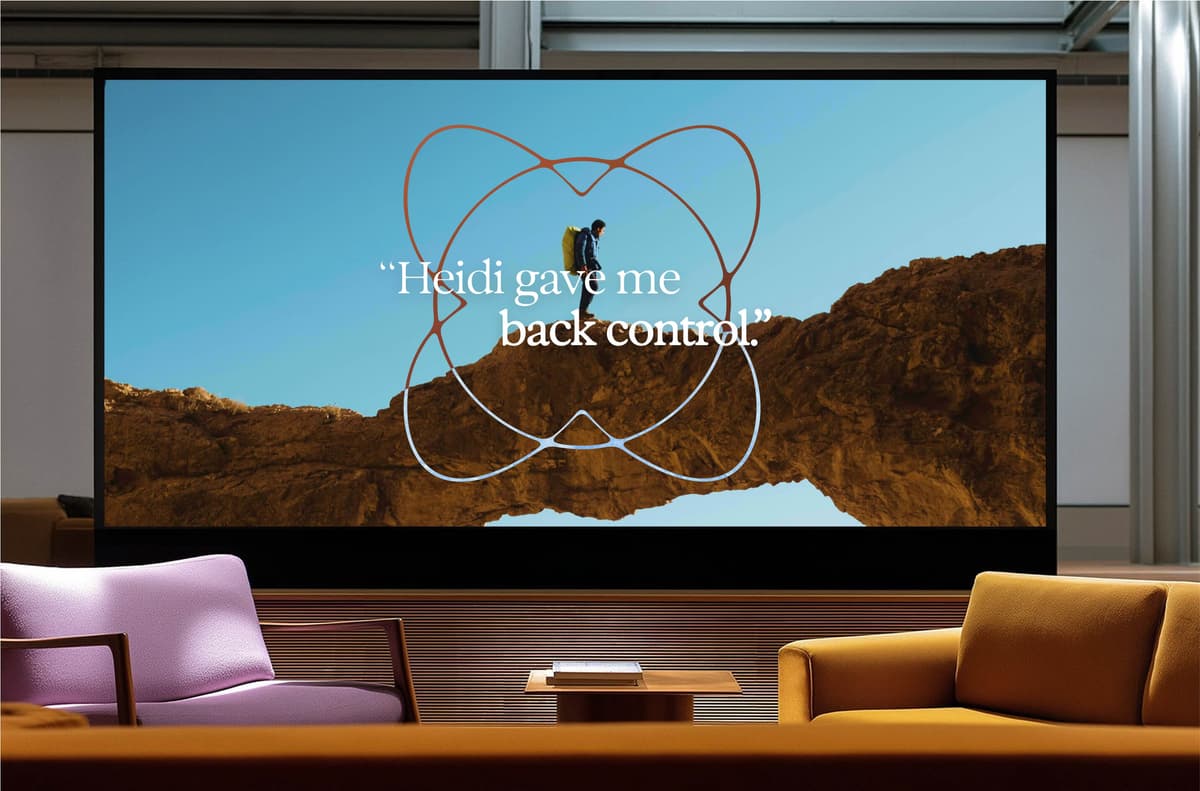
It's all clearly executed and beautifully rendered. The honest question is whether humanity and harmony are now the new boilerplate for healthcare AI, the same way intelligence and spark were the boilerplate for general-purpose AI in 2023. Heidi is doing it well, but the language is becoming load-bearing across multiple healthcare-AI brands, and the visual tells — symmetry, soft motion, organic ripple — are starting to converge across studios.
This is worth writing about because it suggests the cliché map doesn't shrink; it just moves. Each anti-cliché move in one category opens a new convention in another. No glow turns into all ripples. The next-generation critique is going to be about whether "human-centered AI" branding has become its own visual genre.
Sierra: the brand that needed sound
Sierra — the conversational-AI platform from former Salesforce co-CEO Bret Taylor — is the case in the set where the visual identity is only half the story. The marketing site, by Bakken & Bæck, is a calm, modular illustration system around the company's "Agent OS" framing. The audible identity is by Plan8, and it's a separate published case in its own right.
The Plan8 work is the more important argument. Sierra's product is voice-first; users are going to spend more time hearing it than seeing it. The sonic system establishes a vocabulary for the agent's micro-interactions — confirmation, acknowledgment, thinking, handoff — that has to feel coherent over the phone, in a contact center, and inside an enterprise tool. It's brand work, but it's also UX work; the sonic logo is doing the same load-bearing job that a brand mark does in a visual product.
Sierra is the cleanest case for a thesis the rest of this list circles around: when an AI product has no screen — voice, email, agent — the identity has to migrate out of the logotype and into the medium the user actually experiences. For Sierra, that medium is sound.
Diffblue: one metaphor, held all the way down
Together's identity for Diffblue, the autonomous unit-testing platform, is the case in the set with the most disciplined commitment to a single metaphor. Diffblue's product writes unit tests automatically — a developer-tools job that almost never gets a brand argument, because the audience is supposed to be too cynical for one. The studio chose the simplest visual frame possible: the unit test is a square, and the square is the brand.
Everything in the system follows from that decision. The mark is built from cubes and grids; the wordmark uses pixel- and monospace-leaning details that read as code rather than copy; the motion treats unit tests as small geometric objects that snap into place around the code they cover. There is no orb, no glow, no agent persona, no anthropomorphic mascot. The whole identity is a developer-facing argument that AI testing should feel like a known mathematical operation, not a magical assistant.
The risk Together took with Diffblue is the obvious one: a single metaphor, held this strictly, can collapse into reductiveness. A square is not a complicated idea. What rescues the work is the consistency — across the wordmark, the icons, the motion, and the product UI mockups, the geometry never gets diluted by a "human" cue or an "intelligence" cue. The brand earns its restraint by refusing to apologize for it.
It's a useful counterweight to Suki and Robin in this list. Where those cases avoid AI cliché by reaching for warmth, Diffblue avoids it by reaching for math. Both are defensible; they're aimed at different buyers. A clinician needs presence; a developer needs precision. The work is the same kind of refusal — gradients optional — and Together has a recognizable pattern of treating AI brand work as exact systems rather than mood boards. (Reported designer credits include Ben Wynn-Owen; verify against the studio's own credits before quoting.)
Rogo: institutional cosplay, in finance
Together's identity for Rogo — the "Wall Street AI analyst" — is the strongest case in the set for what enterprise-AI branding actually does. Rogo's promise is dense-data financial analysis at the speed of an analyst; the design problem is that an AI startup founded in the last few years has none of the institutional gravitas that finance buyers reach for by default.
Together's solution is to design as if Rogo already had it. The system uses a restrained finance palette, structured product UI frames, dense data mockups, and typographic choices that feel closer to a hundred-year-old investment bank than to a Series A startup. It's institutional cosplay, in a useful sense: the brand is acting as a credibility prosthetic until the company earns the credibility on its own.
The honest critique is that this kind of work risks becoming indistinguishable from old-money aesthetics — Together's own Tabs and Orum cases sit alongside Diffblue and Rogo in the same lineage. There's a thin line between "designing institutional trust" and "borrowing the visual language of institutions you haven't actually become." Rogo, for now, is on the right side of it. The rest of the studio's portfolio shows the recipe scaling.
Cresta: math as a brand mark
Motto's identity for Cresta, the contact-center AI platform, is the rare case in the set where the mark itself is mathematical. The wordmark is set in Diatype by Dinamo — a precise, contemporary grotesque — and the symbol is built from Lissajous curves, the kind of overlapping wave pattern that shows up when two oscillating signals meet at right angles.
It's a literal metaphor, in a good way: Cresta's product is the meeting point of two signals — the customer's voice and the agent's response — and the mark is what that interaction looks like when you graph it. The motion system extends the curve into a continuous wave, and the broader identity stays restrained enough that the math reads as the idea, not as decoration.
Cresta is the cleanest small-case rebuttal to the gradient school of AI design. You can convey signal and intelligence with mathematics, with precise typography, and with a single curve. You don't need a glow.
What it adds up to
A few things become clear when you look at twelve of these cases at once.
The cliché map has visibly shifted. From 2022 to 2024, the dominant moves were the gradient orb, the four-pointed sparkle, and the soft "intelligence" glow. By 2025 and into 2026, the dominant moves in the work studios are celebrating in case studies are the opposite: civic typography, painted illustration, modular blocks, mathematical curves, sonic identity, and geometric restraint. The new conventions are anti-conventions, which means they're conventions.
Typography is doing more work than logo design. Cohere, Faculty, LangChain, Parloa, and Cresta all hand the central conceptual load to the typeface. The shift makes sense: AI products live more in text than in image, and a typographic argument is one the user actually encounters. Logos are seen on the marketing site; type is seen in the product.
Sound is the missing brand layer. Only one case in the set — Sierra, with Plan8 — has a published sonic identity, and it's a stronger argument than most of the visual systems around it. As more AI products move into voice, agents, and screenless surfaces, sonic design will go from a luxury to a brand requirement.
The product UI is still the missing image. Across most of these cases, the studios sell brand systems, launch sites, motion, and metaphors — but show very little of the actual product surface where AI trust is won or lost. Suki's clinician-presence indicators, Rogo's analyst frames, Diffblue's test-coverage view, Heidi's clinical scribe view — those are the screens where the brand argument either holds or collapses, and they're often missing from the case studies.
The strongest AI brands in this set are not arguing about how AI looks. They are arguing about what AI is allowed to do.
The quiet thesis under all twelve cases is that the design problem in AI is no longer "how do we visualize intelligence?" — that problem is exhausted, and the answers (sparkles, gradients, orbs) are now the cliché. The new design problem is permission: how do we get a clinician to talk to a microphone, a lawyer to trust a draft, a CFO to take an analyst memo from a model, a developer to let an agent ship code? The brand work that matters is the work that makes that permission feel earned.
Twelve case studies in one calendar year is not a movement. But it's enough to suggest that the next generation of AI brand work won't look like AI at all. It will look like healthcare, or law, or civic infrastructure, or a sound. And the studios doing it best — BUCK, Otherway, Play Studio, NaN, Koto, Pentagram, DixonBaxi, Bakken & Bæck, Plan8, Together, Motto, Further — are quietly setting the conventions of the next cycle by refusing to repeat the conventions of the last one.